
CLICK HERE FOR BLOGGER TEMPLATES AND MYSPACE LAYOUTS »

Monday, December 15, 2008

InfoTrends projects camera-phone shipments will grow to over 900 million by 2010, and that over 220 billion photos will be taken with cameraphones in the same year - more than film and digital still cameras combined. kameraflage is technology specifically designed to tap this exploding audience.

kameraflage is:

~ Context-Sensitive Display Technology. kameraflage technology encodes a layer of information that can only be viewed by the human eye when looking at an image of the scene taken by a camera.

kameraflage is not:

~ Software: No software needs to be installed on a camera-phone or digital camera for kameraflage to work. This ensures a very large potential user-base.

kameraflage billboard:

~ kameraflage billboard technology allows advertisers to place messages in new locations and situations. There are locations where it is currently inappropriate to place branded messages. This is true for historic locations, galleries, museums, etc. Using kameraflage billboard advertisers can place their messages in these locations without altering the naked-eye experience. As soon as someone takes a photograph your message becomes apparent.

Encourage audiences to seek out your messages. Build your brand around an interactive experience, where discovery, sharing and technology play a leading role.

kameraflage fashion:

~ kameraflage fashion forces people to think about the reproduction of images in the age of ubiquitous digital imaging devices. Kenneth Cole once said that "In cities everyone is on camera hundreds of times each day. Will you be dressed for it?". kameraflage is uniquely positioned to allow designers to create garments and accessories that speak specifically to those who are viewing through a digital camera viewfinder or who view the resulting digital image.

kameraflage allows for a new level of expression for those who are required to wear a uniform. Students at private schools and employees of chain-stores will be able to express themselves to their cameraphone toting peers. Will entities that seek to enforce dress-codes be able to combat this technology? Because it is only perceptible within the confines of mediated reality (cyberspace), yet exists in physical-reality, any attempt to control this form of expression will result in forcing people to discuss this decidedly modern grey-area.

Our first hand-made prototype was worn by international model Anina at the 2006 Fall Fashion Week in Paris, France.
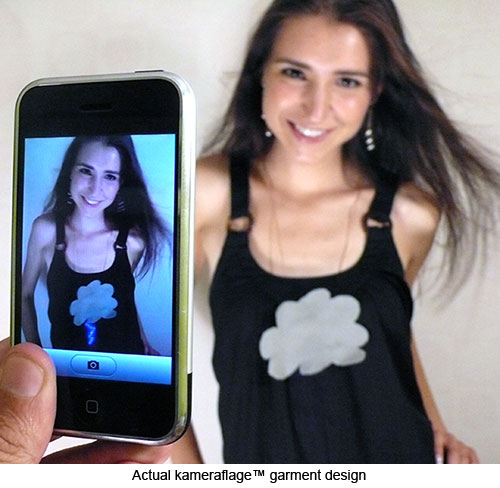

In the photo above you can see that the thunder-cloud has a lightening-bolt appear in the photograph. This and other designs will be showcased at the ACM SIGGRAPH Unravel fashion show on August 6th in San Diego, California.

Camera 'looks' through clothing
Scanner
All objects emit terahertz radiation
A camera that can "see" explosives, drugs and weapons hidden under clothing from 25 metres has been invented.

The ThruVision system could be deployed at airports, railway stations or other public spaces.

It is based on so-called "terahertz", or T-ray, technology, normally used by astronomers to study dying stars.

Although it is able to see through clothes it does not reveal "body detail" or subject people to "harmful radiation", according to the designers.

"It is totally and utterly passive - it receives only," said a spokesperson for Thruvision.

The portable camera, which has already been sold to the Dubai Mercantile Exchange and Canary Wharf in London, will be shown off at the Home Office scientific development branch's annual exhibition later this week.

Body glow

Unlike current security systems that use X-rays, the ThruVision system exploits terahertz rays, or T-rays.

This electromagnetic radiation is a form of low level energy emitted by all people and objects.

These are able to pass through clothing, paper, ceramics and wood but are blocked by metal and water.

The system works by collecting these waves and processing them to form an image which can reveal concealed objects.

"If I were to look at you in terahertz you would appear to glow like a light bulb and different objects glow less brightly or more brightly," said the firm's spokesperson.

"You see a silhouette of the form but you don't see surface anatomical effects."

In addition, the system does not involve any of the "harmful radiation associated with traditional X-ray security screening", according to the firm.

The company has made previous versions of the camera, but the T5000, as it is known, is the first that works both indoors and out.

The system exploits technology originally developed at the government owned Rutherford Appleton Laboratory (RAL) in Oxfordshire.

"Astronomers use T-ray cameras that can see through dust and clouds in space, revealing what lies beyond," explained Dr Liz Towns-Andrews, of the Science and Technology Facilities Council which runs RAL.

Other terahertz systems, developed by companies such as TeraView, are used to probe the structure of pharmaceutical compounds.